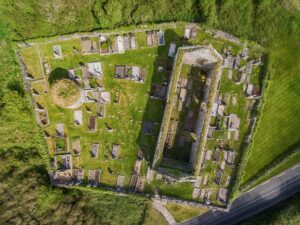
No earthwork rises above ground level; what survives is a ditch and the levelled traces of an internal bank, the kind of remains that would read as unremarkable field ground to anyone walking over them without instruments. The feature sits roughly twenty-five metres east of a ring-barrow, a low burial mound typical of the Bronze Age, suggesting that this corner of the hill was a place of deliberate, repeated human activity at some point in prehistory.
The enclosure came to light through work by the Irish Fieldschool of Prehistoric Archaeology, based at NUI Galway, and was partially excavated in 2018, with findings subsequently published by Ó Maoldúin in 2020. Geophysical survey, which maps subsurface features by measuring variations in soil conductivity or magnetic properties rather than by digging, is increasingly how such sites enter the archaeological record in Ireland, particularly where above-ground traces have been erased by centuries of agriculture or erosion. The excavation at Knockloon Hill was not completed, and further fieldwork was planned to continue the investigation, meaning the site's date, function, and relationship to the nearby ring-barrow remain open questions.