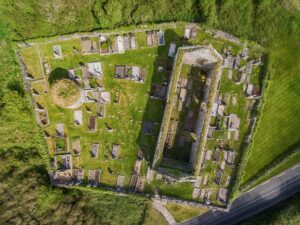
Listed in both the Sites and Monuments Record and the Record of Monuments and Places during the 1990s simply as an "Enclosure", it carried the quiet implication of age and archaeological significance that such a designation tends to suggest.
When the site was physically inspected in 1997, the picture that emerged was rather more modest. The enclosure is defined by a drystone wall, a construction method in which stones are fitted together without mortar, rising to roughly a metre in height. That wall, it turned out, is of modern construction. At the centre sits a grass-covered cairn of material arranged in an L-shape, the origins and purpose of which the inspection does not elaborate on. The site had been identifiable from an aerial photograph, which is likely how it attracted official attention in the first place, but proximity revealed it to be a small field rather than an ancient monument.
What makes Moheraroon quietly interesting is not what the enclosure is, but what the episode illustrates. Archaeological records compiled from aerial survey are necessarily provisional, and sites that photograph as enclosures from the air do not always prove to be enclosures in any ancient sense on the ground. The rocky knoll setting, the oval form, the stone boundary, all of these features can mimic early medieval or prehistoric field systems convincingly enough at altitude. The 1997 visit resolved the question, but by then the listing had already passed through two national records.