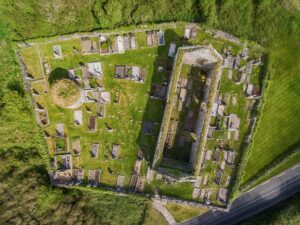
The particular group known as Farm RH1 consists of three or four conjoined, overlapping enclosures, each roughly 60 to 70 metres across, their boundaries formed not by mortared stonework but by very large slabs set upright on edge. The overall effect is less a ruin than a kind of exposed skeleton, the bones of domestic life laid bare across the limestone.
What makes the site quietly extraordinary is the depth of landscape it belongs to. Survey and excavation work published by Jones and colleagues in 2011 revealed that Roughan Hill sits within a prehistoric field system stretching roughly 2.5 kilometres north to south and 1.5 kilometres east to west, incorporating cairns, megalithic tombs, and sections of ancient mound wall alongside the farm enclosures. It is, in other words, not an isolated monument but one node in a coherent, planned agricultural landscape. Within the Farm RH1 enclosures, excavation in 1995 uncovered a house site that produced evidence of two entirely separate periods of occupation: one dating to the late Neolithic or Early Bronze Age, meaning roughly four to five thousand years ago, and a second from the early medieval period, perhaps a thousand years later. That a house site should be reoccupied after such an interval is a reminder that useful ground tends to be recognised across generations, regardless of how much time separates them.