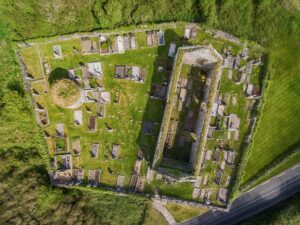
The enclosure at Parknabinnia is oval in shape, roughly 80 metres along its longer axis and 40 metres across, its boundary formed by very large slabs of stone set upright on edge. A smaller enclosure adjoins it to the west, suggesting a complex of spaces rather than a single pen or yard, the kind of arrangement a family might organise around the needs of animals, storage, and daily life.
What makes the site particularly arresting is that it does not stand alone. Survey and excavation work, published by Jones and colleagues, has traced a prehistoric landscape across Roughan Hill and the surrounding area that extends roughly 2.5 kilometres north to south and 1.5 kilometres east to west. Within that space lie cairns, megalithic tombs, and long sections of prehistoric mound wall, all elements of what appears to have been a coherent, organised field system. Four farms, including the Parknabinnia enclosure, are clustered within 200 metres of one another on Roughan Hill itself, suggesting a community rather than isolated homesteads. Excavation in 1995, limited in scope but revealing in its results, recovered domestic artefacts and animal bone refuse. Radiocarbon dating placed the occupation firmly in the Beaker period and the Early Bronze Age, broadly the late third and early second millennia BC, a time when pottery styles associated with the Beaker culture were spreading across Atlantic Europe and settled farming was well established in Ireland.
The limestone pavements and thin soils of the Burren have a well-known tendency to preserve what softer ground elsewhere would have swallowed, and Roughan Hill is a clear example of that quality. The field walls and enclosures here are not reconstructions or approximations; they are, in large part, the original stones, still standing roughly as they were left.