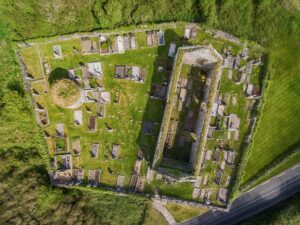
It is one of three conjoined enclosures forming what archaeologists have designated Farm RH5, and it is part of something considerably larger than it first appears: an entire prehistoric farming landscape, complete with field boundaries, cairns, and megalithic tombs, spread across roughly two and a half kilometres from north to south.
Excavation and survey work, published by Jones and colleagues in 2011, pieced together just how organised this landscape once was. The field system, built from prehistoric mound walls, essentially walls constructed from accumulated earth and stone rather than dry-laid courses, covers an area of around two and a half by one and a half kilometres, and within it four separate farm clusters sit within two hundred metres of one another on Roughan Hill alone. Farm RH5 is one of these clusters, made up of three subcircular enclosures joined together, each sharing a wall with its neighbour. Limited excavation at RH5 produced lithic artefacts, worked stone tools and flakes, consistent with those found at the other farms on the hill. Combined with the form of the walls and their integration into the broader mound wall system, this points to a Beaker period and Early Bronze Age date, placing the enclosure's origins somewhere around the late third to early second millennium BC. The Beaker period takes its name from a distinctive style of pottery found across Atlantic and central Europe, and its presence in Ireland marks a period of significant cultural and technological change.
The enclosure at Parknabinnia is not a solitary curiosity but one piece of a landscape that, once you know to look for it, reads almost like a map of how people organised their lives on these hills millennia ago.