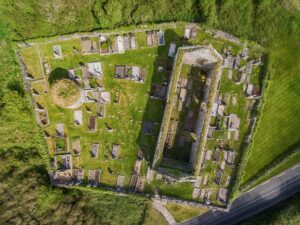
The enclosure is defined by a bank running north to south, visible on aerial mapping but easy to overlook on the ground, where the vegetation has crept in and softened what was once a deliberate boundary. What makes this particular spot quietly arresting is not the enclosure itself in isolation, but the density of ancient activity around it, as though the hilltop at Sheshymore drew people back, in different eras and for different purposes, over a very long stretch of time.
Within roughly eighty metres of the enclosure, several distinct monument types cluster together. To the south-east lies a cashel, a type of stone-walled ringfort typically associated with early medieval farmsteads, and beyond that, a cairn containing two cists, stone-lined burial chambers of the kind usually associated with the Bronze Age. To the east sits a rectangular enclosure accompanied by a souterrain, an underground stone-built passage or chamber that in early medieval Ireland served variously for storage, refuge, or ventilation of a settlement above. The townland boundary between Ballyganner South and Sheshymore runs along the northern edge of the enclosure, a reminder that administrative lines drawn centuries ago sometimes followed even older features in the landscape. Taken together, this small plateau preserves a layered sequence of human use spanning, in all likelihood, several thousand years.
The site sits within rough pasture and hazel scrub on a west-facing slope, and the surviving earthwork bank is the primary visible feature for anyone exploring the area. The neighbouring monuments to the south-east and east are all within easy walking distance of one another, making the hilltop a compact but genuinely complex archaeological landscape.