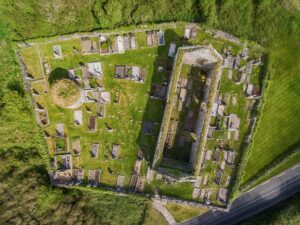
Roughly subrectangular in shape, it is bounded on most sides by an apparently modern drystone wall, but at its north-north-west corner the boundary is simply the natural rock of the terrace itself, the landscape doing the work that a builder might otherwise have done. That detail, easy to walk past without noticing, is what makes the place quietly interesting: the line between human construction and raw geology is genuinely blurred here.
The antiquarian Thomas Johnson Westropp noted the structure in 1896, describing it as a straight-sided enclosure that may have served as a cattle pound or pen. Westropp was a prolific recorder of Clare's field monuments, and his passing mention suggests the enclosure was already considered unremarkable enough to warrant only a brief note. It appeared on the 1916 Ordnance Survey six-inch map marked by a solid line, which gave it an air of established significance, but when the site was inspected in 1999 the picture became more complicated. The walling looked modern rather than ancient, and whatever earlier form the enclosure may have taken, what survives today is a relatively recent construction making use of a convenient natural boundary. It sits around seventy metres south-east of Cashlaungarr, a cashel, which is a type of stone-walled early medieval enclosure typically associated with a farmstead or settlement, and that proximity may once have given Tullycommon's enclosure some functional relationship with the larger monument nearby.