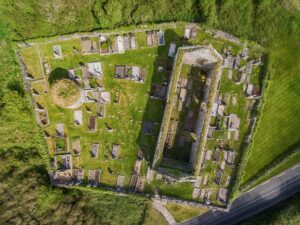
It is roughly nine metres north to south and five metres east to west, rising no more than seventy centimetres at its highest point. That modest hump, irregular in shape and uncertain at its southern and western edges, is composed of burnt stone and ash, the characteristic debris of a fulacht fia. A fulacht fia is a type of prehistoric cooking site, typically found near water, where stones were heated in a fire and then dropped into a trough to boil water. The material thrown aside after each use accumulated over time into the horseshoe-shaped or irregular mounds that survive across Ireland in their thousands.
This particular site came to official notice through a map annotation made by Tom Coffey in 1994, which indicated not one but two fulachtaí fia in the area. On the strength of that annotation, the site was entered into the Record of Monuments and Places in 1996. When an inspection was carried out five years later, in 1999, only this one mound could be located. The second monument, whatever its original basis, left no trace that investigators could find. The surviving mound has no firm dating from the notes available, though fulachtaí fia as a class are most commonly associated with the Bronze Age, roughly 2000 to 500 BC, and are frequently found in low-lying, waterlogged ground, which the surrounding rush-covered field suggests has long been the character of this spot.