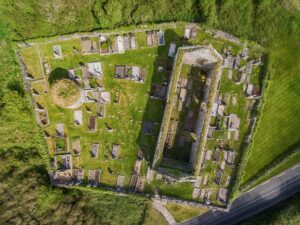
To the untrained eye it might appear as nothing more than a low, horseshoe-shaped mound of burnt and cracked stone, perhaps a natural rise in the ground. But these spreads of fire-shattered rock are among the most widespread prehistoric monuments in Ireland, and their presence at Coad places this otherwise unremarkable patch of ground within a tradition stretching back to the Bronze Age.
Fulachtaí fia, to use the Irish plural, are generally interpreted as outdoor cooking sites, though their exact purpose has been debated by archaeologists for decades. The typical arrangement involves a trough, often timber-lined and sunk into the ground to hold water, alongside a hearth and a mound of the discarded burnt stone that accumulated after repeated use. The method is straightforward: stones were heated in a fire and then dropped into the water-filled trough, bringing the water rapidly to a boil. Over time, the thermally fractured stones became useless for reheating and were simply raked aside, building up the characteristic mound that survives in the ground today. Some researchers have proposed alternative uses, including bathing or textile processing, and it is likely that different sites served different purposes at different times. What places them firmly in the prehistoric record is their association with Bronze Age radiocarbon dates at excavated examples across the country, though many remain undated individually.