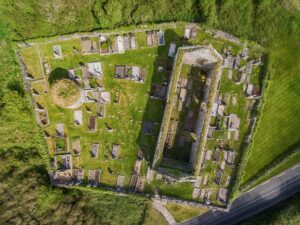
The one at Commons in County Clare is a typical example of a type that is, in its own quiet way, deeply strange. These low, horseshoe-shaped mounds, usually found near water, are the accumulated debris of repeated heating events: fire-cracked stones, dumped again and again after being used to boil water in a trough, most likely during the Bronze Age. The mounds are, essentially, ancient spoil heaps, and they appear in almost every townland in Ireland, yet who used them, and precisely why, remains a matter of genuine debate among archaeologists.
The standard interpretation holds that fulachtaí fia functioned as cooking sites, a kind of field kitchen where stones were heated in a fire and then dropped into a water-filled wooden or stone trough to bring the water to a boil. Experiments have shown the method works efficiently enough to cook large joints of meat. Other theories have proposed uses ranging from textile processing to bathing. The name itself, sometimes translated loosely as "burnt mound" or associated in folklore with the roving bands of the Fianna, reflects how long these features have caught the Irish imagination without ever quite yielding their secrets. The Commons example adds one more data point to a distribution that, taken as a whole, tells us something remarkable about the density of Bronze Age activity across the Irish landscape.