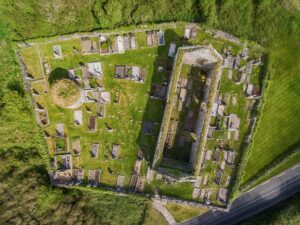
It is a fulacht fia, one of the most common yet persistently mysterious monument types in the Irish archaeological record. These are the remains of ancient cooking sites, or possibly bathing places, or perhaps sites used for brewing or textile preparation; the honest answer is that nobody is entirely certain. What is known is that they appear in their thousands across Ireland, typically dating from the Bronze Age, and that their defining feature is a horseshoe-shaped mound of heat-shattered stone surrounding a depression where a timber-lined trough once held water. Stones were heated in a nearby fire, then dropped into the trough to bring the water rapidly to a boil.
The mechanics are straightforward enough, but the people who used this particular site at Rinnamona left no names, no written record, and no obvious reason why they gathered here rather than somewhere else. The townland itself sits in the broader landscape of west Clare, a region with a deep concentration of prehistoric activity, where the thin soils over limestone have preserved earthworks that elsewhere were long ago ploughed away. The presence of a fulacht fia here is unremarkable in statistical terms, in that the monument type is so widespread, but each one represents a specific, repeated human activity at a chosen spot, presumably near a reliable water source, carried out over what may have been generations.