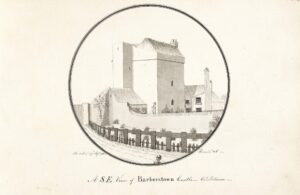
At the southern end of a long formal avenue on the Killadoon Demesne in County Kildare, a small L-shaped graveyard sits about a metre higher than the surrounding ground, its raised interior a clue that the dead have been accumulating here for a very long time. The enclosure is bounded on most sides by a low mortared stone wall, but to the south it simply meets the outbuildings of the courtyard belonging to Killadoon House, making it an oddly domesticated space, pressed up against the working margins of a landed estate. Inside, ivy, ash, holly, laurel, and briar have taken over almost entirely, and the whole area has the quality of somewhere that was quietly set aside and then quietly forgotten.
The earliest headstone that can still be read dates to 1816, though the ground itself almost certainly holds older burials. Near the centre of the enclosure, the foundations of a ruined church survive just below the vegetation. A church with a graveyard of this kind would typically indicate a site of medieval or early Christian origin, the congregation long gone but the burial ground continuing in use, as was common practice across rural Ireland, well into the modern period. The relationship between the graveyard and the demesne landscape around it is a familiar one in Irish history; as estates were laid out and improved during the eighteenth and nineteenth centuries, older ecclesiastical sites were sometimes absorbed into the designed grounds, left intact out of custom, legal obligation, or simple superstition about disturbing the dead.