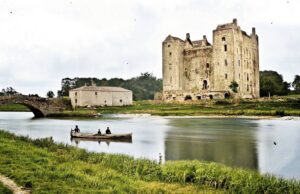
What visitors rarely consider is that the ground beneath and around the present site was once a functioning Anglo-Norman borough, complete with a hundred court, a shambles, a fish-pond, a watermill, a rabbit warren, and a weekly market. A 14th-century Irish text, the Caithréim Thoirdhealbhaigh, describes the place as 'Bunratty of the wide roads, oared galleys and safe harbour', which suggests a settlement of genuine urban character, one that controlled the movement of shipping on the Shannon from a low hill at the mouth of the Owenogarney River.
The name itself, from the Irish 'Bun Ráite', means the mouth of the Ráite, and the location was chosen with military logic. Well into the early 20th century the area was still surrounded by marshes to the south, west, and north, isolating it at high tide in a way that would have made it naturally defensible. The Norse were apparently here first: the 12th-century chronicle Cogadh Gaedhel re Gallaibh records that around 960 the Vikings of North Munster built a fort at 'Tratraighe', the older name for this territory, though its precise position has never been established. The formal Anglo-Norman settlement dates from 1248, when the area was granted to Robert de Muscegros; by 1253 he had secured the right to hold a market and fair. By 1287, under Thomas de Clare, a manor extent recorded 226 burgages, a burgage being a standard unit of urban landholding, held by the town's burgesses at an annual rent. That degree of administrative detail points to a functioning town, not merely a castle with a handful of dependent buildings. The whole enterprise unravelled after the defeat of Thomas de Clare's son Richard at the battle of Dysert O'Dea in 1318. An inquisition taken on Thomas's death in 1321 found the houses below the castle 'dilapidated and in ruins and cannot be reckoned as dwellings'. The castle was captured and destroyed by Muirchertach Ó Briain and MacConmara in 1332, repaired by Sir Thomas de Rokeby in 1353, and the present tower house was built in the 15th century, attributed to Maccon MacNamara, most likely on the footprint of earlier structures.
Archaeological excavations carried out in 1990, 1991, and 2000 have complicated the picture in interesting ways. Earthworks that an early 20th-century antiquary had mapped as possible medieval town defences turned out, on excavation, to be 17th century in origin. A more convincing medieval feature emerged closer to the town centre: a substantial east-west ditch more than eight metres wide, with finds dating it to the 13th and 14th centuries. Excavations near the late medieval church produced pottery of the same period, including Adare-type ware, a recognisable ceramic tradition from the region. The archaeology does not restore the vanished town, but it confirms that something considerable once occupied this marshy ground between the river and the Shannon.