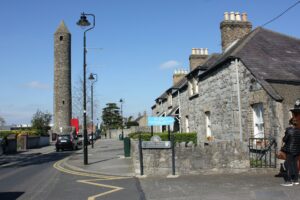
At some point between the 1970s and now, a large bush that had stood at the crossroads long enough to earn a name on an Ordnance Survey map was cleared away, leaving no visible trace at ground level. It is the kind of erasure that happens quietly, without record or ceremony, and which the landscape simply absorbs.
The bush appeared on the OS edition surveyed between 1936 and 1937 under the name "bush of Balgarry", a designation that hints at something more than an incidental piece of vegetation. Holy bushes and holy trees, typically hawthorns, were a recognised feature of the Irish countryside, associated with fairy lore, local veneration, and, in many cases, proximity to a holy well or ancient gathering place. They occupied a category somewhere between the sacred and the folkloric, and were treated with enough seriousness that people were often reluctant to cut them down. The fact that this one was named on a mid-twentieth-century map suggests it was still considered significant, or at least noteworthy, within living memory. By 1974, researcher Geraldine Stout recorded it as a large bush still standing at the road junction, which means it survived into the modern era before being removed sometime after that visit.
The site sits in Balgaddy, in County Dublin, an area that has seen considerable development over recent decades. The road junction where the bush once stood would be the place to look, though as the notes make clear, there is nothing visible remaining at ground level. For anyone with an interest in the quieter layers of landscape history, that very blankness carries its own significance; the name persisted on maps, the bush persisted into the 1970s, and now both are gone. It is the kind of site that rewards attention not for what you can see, but for what it prompts you to consider about how ordinary-looking places accumulate meaning over time, and how easily that meaning can be lost.