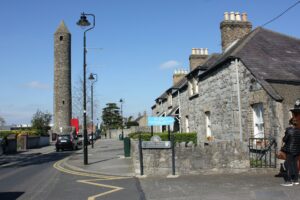
No marker, no plaque, no shrine of any kind survives above ground. The well that locals called St. Kevin's Well has been swallowed entirely by twentieth-century development, leaving only the folklore intact.
The well sat beside Kilnamanagh Castle, in the parish of Tallaght, and according to the folklorist Caoimhín Ó Danachair, writing in 1958, it was never particularly devotional in character. He noted that there was no memory of religious practices being performed there, and that the water was used for domestic purposes only. What distinguished it was its legend. It was at Kilnamanagh, according to tradition recorded by children at St. Mary's School in Tallaght, that St. Kevin spent his novitiate, the period of early training before taking religious vows. While absorbed in reading his office one day, he attracted the attention of a woman named Kathleen, who returned repeatedly and eventually tried to speak to him. Kevin, famously austere in such matters, struck her across the face with a handful of nettles and told her to leave. Kathleen immediately fell to her knees in contrition, and at that spot a well is said to have sprung from the ground. The same school collection notes that by the time the story was recorded, the water had been redirected through a drain to the other side of the castle. Writing in 1944, Ua Broin described visiting the well via steps to the south-west of the castle, and mentioned a nearby mound between a shed and the passage leading to it. A second well marked on older Ordnance Survey maps nearby was not, according to local tradition, considered a holy well at all.
The well was recorded as still present in 1975, but the subsequent construction of housing across this ecclesiastical site has left no surface trace whatsoever. There is nothing to see at Kilnamanagh today that corresponds to the well or its surroundings. Its interest now is almost entirely archival, belonging to the Dúchas Schools' Collection and to the layered ecclesiastical landscape of an area that has otherwise been thoroughly transformed.