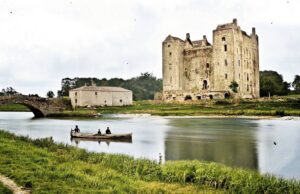
The mound itself is the more visible feature, but the house that preceded it is in some ways the more quietly strange discovery.
In 1959, the antiquary John Hunt excavated the mound and found, close to its western edge, the low brick foundation of a timber-framed building dating to the sixteenth century. The foundation wall, roughly 0.6 metres in height, was well mortared and sat on a stone and mortar base laid directly on the clay subsoil. A clay floor survived just below the level of the highest brick course. Hunt interpreted the structure as a typical late Gothic or Tudor domestic building, with the low brick dwarf wall supporting a frame of timber infilled with lath and plaster. At some point the building was destroyed by fire; a dense black layer of burnt material still lay across the old habitation surface and sloped up against the mound that was subsequently raised over the ruins. That mound, Hunt argued, was the artillery emplacement for four cannon mentioned by Admiral Penn in his account of the defence of Bunratty Castle in 1646, during a siege by Confederate forces. The position would have commanded a broad channel of water that then separated the castle from higher ground to the north. A protective barrier of logs or gabions, which are essentially basket-like cages filled with earth used as field fortifications, was likely erected on the mound's crest; its burning after the castle's capture by the Confederates accounts for the scorched deposits found in the surrounding fosse, the defensive ditch dug when the spoil for the mound was first excavated. The finds recovered from the layers around the house foundation and the mound itself included an iron knife, fragments of a seventeenth-century glazed cooking pot, a piece of a glass wine bottle, and a sherd of salt-glazed stoneware of late sixteenth-century type.