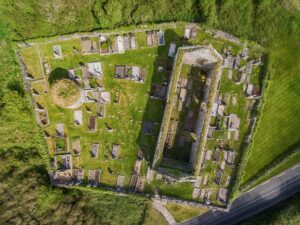
What makes this modest ruin worth a second look is not the structure itself but its relationship to its neighbours: two other houses, one just two metres to the north and a larger three-roomed example roughly fifteen metres to the east, appear to have been arranged around a square, suggesting that this was not a single isolated dwelling but part of a small, deliberately planned cluster.
The house measures eight metres east to west and just under ten metres north to south, with the wall surviving to a maximum height of around 0.4 metres at the southern end. When examined in 1998, it was dated to the 18th or 19th century, placing it in a period of considerable rural pressure in Clare, when the subdivision of land and the consolidation of households around shared yards was a practical response to both family need and the demands of farming. The grouped layout, three houses sharing a common orientation around an open square, points to that kind of domestic logic rather than to chance proximity. Fifty metres to the east, an older cashel sits in the landscape; a cashel is a stone-walled enclosure, typically of early medieval origin, used to protect a farmstead or settlement. Its presence nearby is a reminder that this particular patch of hillside has attracted settlement across very different centuries.