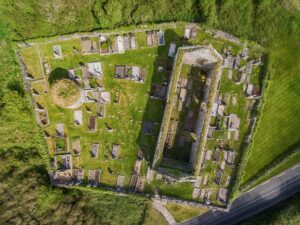
At Caherblonick in County Clare, the grass-covered remains of a one-roomed house on a north-facing slope form part of exactly such a grouping, its low walls still legible despite centuries of weathering and encroaching vegetation.
The house is modest in scale, measuring roughly twelve metres east to west and just over eight metres north to south, with its western edge angling out slightly to the northwest. When inspected in 1998 it was dated to the eighteenth or nineteenth century, placing it within the period of intense rural settlement that preceded and then collapsed around the Great Famine. Two metres to the south lie the remains of a second house, and roughly fifteen metres to the east stands a third, a three-roomed structure, the largest of the cluster. Together, the three appear to have been deliberately arranged around a central open space, suggesting a degree of shared planning rather than piecemeal building over time. Adding further depth to the site, a cashel sits just fifty metres to the east. A cashel is an early medieval stone enclosure, usually circular, built to protect a farmstead or small settlement, and its proximity here hints at a landscape that was already organised and inhabited long before the later houses were raised beside it.