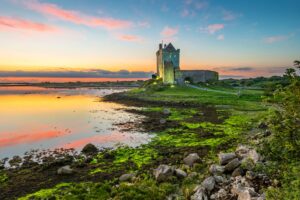
It is the kind of place that feels geographically peripheral, which may explain why a house from the eighteenth or nineteenth century there can sit in the record with so little attached to it. The peninsula has long attracted attention out of proportion to its size, and any substantial structure from that era would have belonged to a landscape already layered with meaning.
The house dates to somewhere between the late 1700s and the early 1800s, a period when the west of Ireland saw both the consolidation of Anglo-Irish landed estates and, later, the severe pressures of pre-Famine and Famine-era decline. Doorus itself carries a particular cultural footnote: the house at Doorus was at one point associated with Count Florimond de Basterot, a French-Irish aristocrat who maintained a residence on the peninsula in the late nineteenth century. It was at Doorus that W.B. Yeats, Lady Gregory, and Edward Martyn famously discussed the idea that would become the Irish Literary Theatre, the forerunner of the Abbey. Whether the recorded structure is connected to de Basterot's house or is a separate, more modest building on the same peninsula is not clear from what survives in the public record, which makes it an intriguing loose thread in an otherwise well-documented literary and social history.
Doorus can be reached by a minor road running south-west from Kinvara, through a landscape of low stone walls and coastal scrub. The peninsula is small enough to explore on foot, and the shoreline offers clear views back across the bay towards the Burren hills.