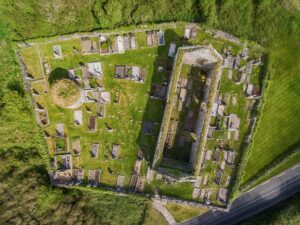
Local tradition held it to be the dwelling of the friars who served a medieval church some 225 metres to the south-west, and that belief settled into the Irish as Tigh na mBráthar, the House of the Friars. The nineteenth-century Ordnance Survey maps rendered this as Tenabrawher and marked it plainly in ruins, which it already was.
G. U. Macnamara, writing in the Journal of the Royal Society of Antiquaries of Ireland in 1897, recorded what was then still visible: rounded quoinstones at the corners, and a doorway roughly 91 centimetres wide set into the centre of the south-western wall. Quoinstones are the dressed corner-blocks used to strengthen and define the angles of a masonry building, and their rounded form here is a modest but telling detail. The structure itself is small, its internal dimensions running about 5.35 metres by 2.8 metres, with double-faced walls that survive in places to only 20 to 50 centimetres in height. A later drystone wall, the kind built without mortar using carefully stacked stone, was added on top of the original fabric at some point, complicating any reading of the earlier construction. The south-eastern end is choked with rubble. Robinson's map of the Burren in 1977 named the site, anchoring the local tradition in print, though its formal status remained cautious: listed in 1996 as a potential site identified by placename rather than confirmed structural evidence.
Around the building, small rectangular fields defined by hazel-covered boulder walls hint at a working landscape associated with whoever lived here. About 27 metres to the west lies a bullaun stone, a boulder bearing one or more cup-shaped depressions that are found across early medieval Ireland, often near ecclesiastical sites, and whose precise function remains debated. Whether the building was ever a friary residence, a simple priest's house, or something else entirely, the canyon setting, the nearby church, the old fields, and the bullaun together suggest a corner of the Burren that was once quietly but deliberately inhabited.