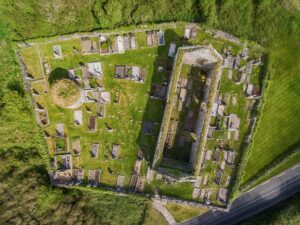
What was recorded as a small oval structure, roughly 3.6 metres long, pressed against the inner face of a cashel wall, could not be found at all when investigators looked for it in October 1998. A cashel is a type of early medieval stone ringfort, typically enclosing a farmstead or settlement, and Caherblonick is one of many such enclosures scattered across the limestone landscape of the Burren. The hut inside it is, by now, more of an absence than a presence.
The earliest description comes from the antiquarian Thomas Johnson Westropp, who wrote about the site in 1905. He found the oval hut tucked into the northern sector of the cashel interior, built directly against the cashel wall and deeply buried under vegetation. His account gives the structure a length of twelve feet, and the detail about moss and cranesbills suggests it was already well on its way to disappearing even then. Westropp also noted a second hut site in the eastern sector of the same enclosure, indicating that the cashel once held at least two such structures. By the time anyone looked again with fresh eyes, nearly a century later, no physical trace of either could be confirmed on the ground. The northern hut may, however, leave a faint ghostly outline: a circular mark visible on aerial imagery from 2021 could indicate where the structure once stood, its footprint preserved just below the surface even as it remains invisible to anyone walking the site.