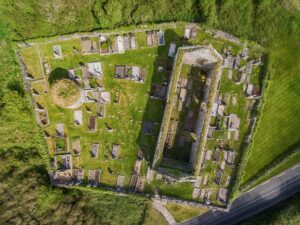
But tucked against the inside of the outermost enclosing wall, at the southern end and just east of one of the radial walls that connect the middle and outer rings, there sits something considerably more modest: a small hut, roughly three metres north to south and two and a half metres east to west, with an entrance facing southeast. It is easy to overlook, which may say something about what it was for.
Cahercommaun is a triple-walled cashel, a type of stone ringfort, thought to date from the early medieval period and excavated in the 1930s. The American archaeologist Hugh Hencken, writing up the results of that excavation in 1938, noted this hut as one of three such structures built against the inner face of the outer wall. His description was not flattering: he called them "roughly constructed", which distinguishes them sharply from the considerable effort that went into the main enclosing walls themselves. The positioning of these huts in the outermost and least prestigious ring of the fort, rather than in the interior enclosure, likely reflects their function and perhaps the social standing of whoever used them. Whether they served as shelters for animals, storage, or the lower-ranked members of a household is not recorded, but their marginal location within an already layered social geography is telling.