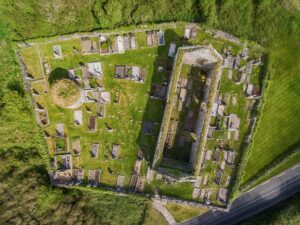
In the north quadrant of a stone enclosure known as Cashlaungarr, in Tullycommon in County Clare, a cluster of hut sites was recorded by the antiquarian Thomas Johnson Westropp, one of several grouped within and around the cashel, which is a type of early medieval dry-stone ringfort. Three huts occupied the northern section of the enclosure, with a fourth positioned at its centre. By the time Westropp revisited the subject in 1915, he noted they had become hardly distinguishable. By 1999, a ground inspection found nothing discernible at all.
Westropp's drawing, published and republished across his writings from the late nineteenth and early twentieth centuries, remains the most concrete evidence that these features ever existed as legible archaeology. His 1915 note is telling: not gone, exactly, but fading, losing their edges against the surrounding ground. The gradual erasure of earthworks and stone features is common in the Irish landscape, where agriculture, weather, and time compress centuries of habitation into undifferentiated humps and hollows. What Westropp captured was essentially a snapshot taken just before the image became unreadable.