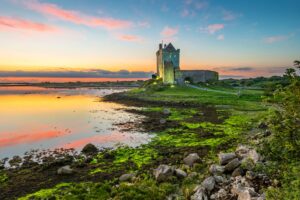
Lime kilns were stone-built furnaces used to burn limestone at high temperatures, reducing it to quicklime, which farmers then spread across acidic land to improve fertility. In a county underlain by the limestone pavements of the Burren, the raw material was never far away, and kilns like this one would have been essential seasonal fixtures, fired up in spring and tended for days at a time.
The Kinvarra kiln sits within a landscape that has been shaped by both agriculture and the sea for centuries. Kinvarra itself was historically a significant point for the trade of turf and grain, with Dunguaire Castle overlooking its small harbour from the sixteenth century onwards. Lime burning fitted neatly into this broader economy of coastal exchange and land improvement, and kilns were often built close to the shore where limestone could be landed from boats and fuel brought in easily. The structure recorded here is a physical remnant of that agricultural calculus, a piece of functional vernacular engineering that rarely attracts the attention given to castles or abbeys, yet was no less central to how the land was worked and fed.