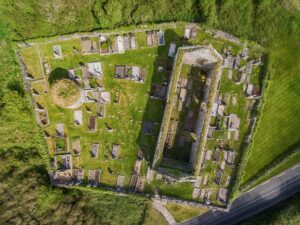
A parish church recorded as 'ruyned' as early as 1615 was not simply left to return to the earth; around 1900, the local authority systematically removed whatever fabric remained standing. The result, on a south-west-facing slope of coarse pasture just south of a public road near Knockroe in County Clare, is a site that registers today as little more than a slight thickening of the ground.
The antiquary Thomas Johnson Westropp, writing between 1900 and 1902, noted the church under its local name 'Kiltorachtagh' and identified it as a parish church, placing it within the wider network of early ecclesiastical sites that once served the rural communities of Clare. By then, the clearance was already under way or recently completed. What Westropp and later researchers were left to work with, and what is still visible on the ground, amounts to the grassed-over foundations of a rectangular building roughly fourteen metres long and five and a half metres wide, with stone and earthen banks rising only about twenty centimetres above the surrounding pasture. An internal wall divides the structure, creating a smaller room at the north-west end, and a narrow gap in the south-east side is thought to mark the original doorway. A scatter of grassed-over rubble to the north-east may be the residue of an associated structure. The site appeared under its current name on Ordnance Survey six-inch maps from at least 1840, and again on the 1916 edition, by which point the church had been a ruin, in one form or another, for the better part of three centuries.
The foundations sit immediately south of a public road and are visible as low, turf-covered banks in the pasture. The internal subdivision and the possible door gap in the south-east wall are the most legible features on the ground, though all of them require a slow, attentive look to read clearly against the surrounding grass.