Somewhere near the old church and graveyard at Whitechurch, there is, or was, a holy well, and nobody can quite agree on where. That uncertainty is, in a way, the whole story. Holy wells are among the most common sacred features in the Irish landscape, typically associated with a patron saint, a feast day, or a tradition of curative rounds, and the name "Lady Well" would ordinarily suggest a dedication to the Virgin Mary. But by the time a nineteenth-century observer tried to pin this one down, even its name had grown uncertain: was it the Lady Well, or the Sunday Well? He could not find out, the custom of visiting it having long since lapsed.
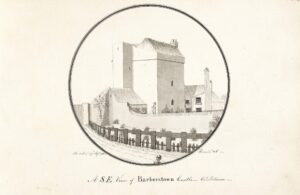
The confusion runs deeper than nomenclature. The observer, writing around the mid-nineteenth century and later cited by Michael Herity in 2002, described two distinct wells in the vicinity of the ruined church. One lay roughly 250 metres to the west, and had been rendered nearly dry by a limestone quarry opened nearby, its waters drained away as a consequence of the quarrying. The other sat within about four yards of a part of the church ruins known locally as "the Castle", though whatever name that second well had ever carried was, by then, entirely forgotten. The first edition of the Ordnance Survey six-inch map, published in 1838, complicates things further: it places the name "Lady Well" not at the more distant western location, but at the one close to the graveyard, just outside its boundary. Whether the cartographers were correcting the record or simply working from different local knowledge is impossible to say now.
No visible surface trace of either well survives today. The site sits within what may have been an ecclesiastical enclosure, a type of roughly circular or oval boundary, often a raised earthwork, that once demarcated early Christian church lands. What remains is a small puzzle about a place that was already half-forgotten before anyone thought to write it down.