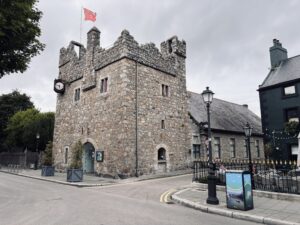
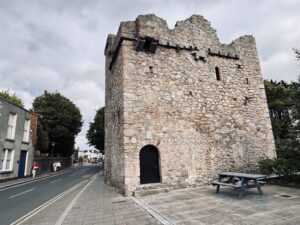
What makes it quietly unusual is not the tower alone but its relationship to the three-gun battery sitting 155 metres to the south-east, together forming a single coordinated defensive position, numbered ninth in a chain of sixteen planned positions running down the Dublin coast. The two structures were designed to function in tandem, the battery covering the open bay while the tower, positioned within musketry range of it, protected the battery itself.
Construction of the Dublin-area Martello towers and their associated batteries began in 1804, supervised by Colonel Benjamin Fisher of the Royal Engineers. A Martello tower is a compact, thick-walled circular fortification, typically with a single elevated entrance to make forced entry difficult. All the Dublin towers were armed and complete by December 1805. The impetus was a fear that had been articulated a full decade earlier: in 1795 the Earl of Carhampton had identified Killiney Bay as a dangerously convenient landing place for an enemy force. The coastal chain was the delayed answer to that concern. The Dalkey Island tower was larger than most in the series, mounting two 24-pound cannon on its circular gun platform. The battery to the south-east, still largely intact, retains its iron rails and pivots for the traversing gun platforms, backed by a ruined guardhouse. Together the guns were directed southward over Killiney Bay, their fields of fire overlapping with those at battery number eight and, more distantly, with tower and battery number six. Solid iron shot from a 24-pounder carried somewhat over a mile; canister or grapeshot could sweep the full width of the beach at low tide.
Dalkey Island is accessible by a short boat crossing from Coliemore Harbour in Dalkey, with seasonal ferry services typically running in summer months. The tower sits on the island's highest point and is visible as soon as you land. The original entrance, as shown in mid-nineteenth-century plans, was in the parapet and reached by a step ladder; the present doorway is a later insertion, set above ground level in the manner of others in the series. No machicolation, the projecting parapet opening through which defenders could drop objects on attackers below, survives above the entrance here, which sets it apart from some of its neighbours. The roof remains intact, with a double string course visible at the top and a plinth running around the base. The battery to the south-east is worth the short walk, particularly for the surviving ironwork of the gun platforms.