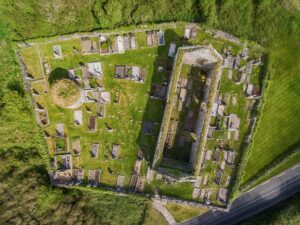
The Burren is one of the most archaeologically dense landscapes in Ireland, a place where Neolithic and Bronze Age communities left behind court tombs, portal dolmens, and wedge tombs in considerable numbers, and where the bare karst terrain has preserved what elsewhere would long since have been ploughed away or built over. That a monument here carries so little documentation in the public record is itself a curiosity worth noting.
Megalithic structures of this region tend to belong to a handful of broad categories. Wedge tombs, the most common megalithic tomb type in Ireland and particularly prevalent in the west, were collective burial monuments built roughly between 2500 and 2000 BC, consisting of a roofed stone gallery that typically narrows and lowers toward the rear. Court tombs are somewhat earlier, featuring an open forecourt leading into a covered burial chamber. Without more specific detail it is not possible to say with confidence which form the Parknabinnia structure takes, but its location places it within a landscape that has been shaped by several thousand years of human activity, much of it still visible at the surface in the form of field walls, fulacht fiadh cooking sites, and ring forts scattered across the grey limestone.
The Burren rewards slow and attentive movement. The density of monuments means that a single walk can bring a person past several sites of different periods, often unmarked and unenclosed, simply sitting in the open as they have for millennia. Parknabinnia itself lies in an area accessible on foot, though the limestone pavement can be uneven underfoot and the light in low season, when the vegetation is sparse and the stone most exposed, tends to sharpen the outlines of anything structural remaining in the ground.