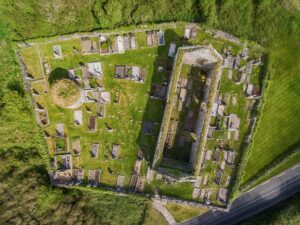
What remains of the structure is fragmentary but legible: a single standing sidestone on the north, a fallen sidestone on the south now lying beneath a broken roofstone, and a large slab at the western end that may once have served as an endstone. The chamber, aligned roughly west-north-west to east-south-east, measures about 2.5 metres in length and 1.5 metres across at its eastern end. Traces of the original mound are still visible along the south side.
Wedge tombs, the most numerous megalithic tomb type in Ireland, are so called because their chambers taper in both height and width from east to west. They are generally associated with the Chalcolithic period and the Early Bronze Age, a span running from roughly 2500 to 1500 BC. This particular example sits within what researchers have identified as the densest concentration of wedge tombs anywhere in Ireland, spread across the townlands of Parknabinnia, Leana, Caherfadda, and Commons North on and around Roughan Hill. Jones and Walsh documented the tomb in 1996, and it forms part of a wider multiperiod field system that points to sustained agricultural and ritual use of the hillside over a very long stretch of time. Excavations at three nearby tombs in the Roughan Hill group, carried out by Ó Maoldúin and published between 2015 and 2022, have confirmed that the local monuments date to the Chalcolithic and Early Bronze Age, giving firm chronological grounding to what was long suspected on typological grounds.
The tomb sits within a working landscape rather than a managed heritage site, surrounded by the field boundaries and earthworks that give Roughan Hill much of its archaeological character. The broken slabs scattered around the chamber are not random debris but almost certainly the displaced remnants of the original roofstone and the collapsed southern sidestone, worth pausing over rather than walking past.