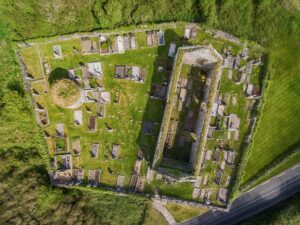
Wedge tombs, so called because their chambers taper in both height and width from front to back, are the most numerous megalithic tomb type in Ireland, and the majority cluster in the west of the country, particularly in areas of exposed limestone like this one. This example, however, has reached a state of considerable collapse, and what remains rewards a certain patience to read.
The tomb was once enclosed within a cairn, a mound of piled stone, which still survives as a grass-covered oval roughly nine metres long and eight metres wide, rising to about eighty centimetres at its highest point. The chamber inside was aligned roughly north to south. Of its original upright slabs, only one remains standing, on the eastern side, nearly three metres in length but quite thin. The large capstone, which would once have roofed the chamber, has toppled and now lies to the north of its original position. A cluster of smaller upright stones nearby may represent the remains of an antechamber, a forecourt-like space at the entrance end of the tomb that features in several wedge tomb designs. The whole structure sits within an ancient field system, its boundaries still legible in the landscape around it, and approximately forty metres to the north-west stands a cashel, a stone-walled circular enclosure of early medieval date, suggesting that this corner of the Burren has been continuously shaped by human activity across several distinct periods.