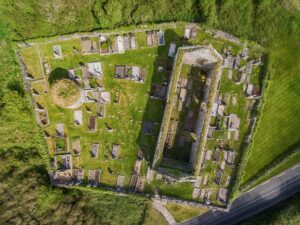
The tomb occupies the north-eastern interior of a cashel, a type of stone-walled enclosure associated with early medieval settlement in Ireland, meaning that two quite different eras of human activity share the same ground. The tomb itself is a wedge tomb, a form of megalithic burial monument built during the late Neolithic and early Bronze Age, characterised by a trapezoidal chamber that is wider and taller at one end and tapers toward the other. Here the structure narrows from around 1.35 metres wide at the south-west to 1.2 metres at the north-east, and drops in height from 1.3 metres to roughly a metre over the same distance. Its capstone, measuring 3.55 metres long and 2.3 metres wide, remains largely intact, resting on two single limestone slabs that form the sides of the chamber. The whole is embedded within an irregular mound approximately 11 metres east to west and 8.5 metres north to south, with traces of what may be original kerbing still visible near the edges.
The tomb was described in detail by Ruaidhrí de Valera and Seán Ó Nualláin in their 1961 Survey of the Megalithic Tombs of Ireland, which remains the foundation of most subsequent understanding of the site. Both sidestones show signs of deliberate dressing along their top edges, which is notable given the monument's antiquity. The backstone has a small opening midway down its north-north-west edge, roughly 45 centimetres high and 25 centimetres wide, with flaked edges that suggest it may have been made intentionally rather than caused by damage. The antiquarian Thomas Westropp, writing in 1898, had interpreted some of the outer stones flanking the chamber as small triangular cists, that is, stone-lined burial boxes, though de Valera and Ó Nualláin later considered these more likely to be the remains of the tomb's outer walling. A tall dressed stone standing two metres high to the south-west of the chamber, and a second slab just to its north-west, form what has been identified as frontal outer walling, adding to the sense that the original monument was more architecturally elaborate than its current state might suggest. The south-west edge of the enclosing mound was disturbed at some point by a later wall, and at least one slab incorporated into that wall may originally have been part of the tomb's south-east outer walling, a reminder that stone was routinely recycled across the centuries in this landscape of rough pasture and sparse hazel.