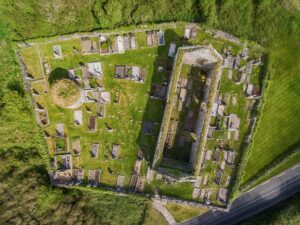
Wedge tombs, so called because their internal gallery tapers in both height and width from front to back, are the most numerous megalithic tomb type in Ireland, and Clare holds a remarkable concentration of them. What makes Parknabinnia worth attention is the way it sits within this dense local cluster, part of a landscape where prehistoric communities returned, again and again, to mark the same glacially scoured terrain with stone.
The principal scholarly record for this tomb comes from Ruaidhrí de Valera and Seán Ó Nualláin, whose survey of the megalithic tombs of County Clare was published by the Stationery Office in Dublin in 1961, the first volume in what became a foundational series for Irish prehistoric archaeology. De Valera had spent years systematically walking and recording megalithic monuments across the country, and the Clare volume drew together fieldwork that established the basic typology still in use today. The Burren, with its exposed karst geography, its thin soils and its absence of later intensive cultivation, preserved these structures in conditions that lower-lying or more heavily farmed regions rarely offered. Parknabinnia falls within that broader pattern of preservation, its stones neither quarried away for field walls nor buried under centuries of agricultural reworking.