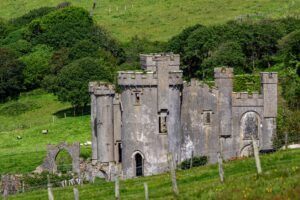
It is a midden, the technical term for a prehistoric refuse deposit, and this one is composed almost exclusively of a single species. That specificity is quietly telling. Middens record not just what people ate but how they organised their foraging, and a deposit dominated by periwinkle suggests a community returning again and again to the same intertidal harvest.
The site sits at Faul, near the head of Clifden Bay in County Galway. Its precise age is not recorded, but coastal middens of this kind are found throughout Atlantic Ireland and western Scotland and are often associated with Mesolithic or Neolithic settlement, periods when shellfish formed a meaningful part of the diet along sheltered estuaries and inlets. The shell layer here survives only because erosion has cut into the deposit and exposed its cross-section; the rest may extend further into the surrounding ground. A standing stone lies close by to the east, a reminder that the area accumulated significance across a long stretch of time, though whether the two features are related in any meaningful way is unknown.