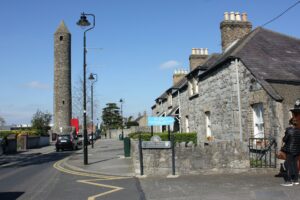
The connection is unlikely and quietly compelling: a bishop and scholar, one of the most learned men of his age, arriving at a monastery and quietly taking on the grinding, practical work of milling grain.
According to Scantlebury, writing in 1960, Saint Óengus the Culdee entered Tallaght monastery sometime in the early ninth century, but he did so in disguise, presenting himself as an ordinary lay brother rather than revealing his identity as a bishop. The Culdees were a reform movement within the early Irish church, emphasising asceticism and communal religious life, and Óengus appears to have taken that spirit to its logical conclusion. He was assigned charge of the kiln and the mill as among his first duties, mundane tasks entirely at odds with his standing as the likely author of the Féilire Óengussa, a celebrated Irish martyrology written in verse, and possibly the Martyrology of Tallaght as well. A martyrology, for those unfamiliar with the term, is a catalogue of saints arranged by feast day, and these two texts are among the most important surviving records of the early Irish church calendar. That their probable author once kept a mill wheel turning at Tallaght is the kind of detail history tends to bury.
The physical trace of this history is faint but not entirely gone. A mill race, the channel cut to direct water onto a mill wheel, appears on the first-edition Ordnance Survey six-inch maps of the area, and according to local researcher Clare Crowley, this feature may follow the course of an early mill race associated with the monastic site. The first-edition OS maps, produced in Ireland during the 1830s and 1840s, are a reliable record of features that have since disappeared or been built over, so it is worth consulting them before visiting. Tallaght itself has changed enormously since those surveys, and the landscape around the old monastic site requires some patience to read. The maps are freely available through the OSi Historical Mapping viewer online, which allows you to overlay the nineteenth-century survey on the modern townland.