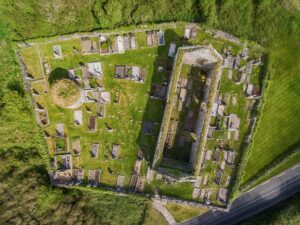
It is not large, rising only between 1.2 and 1.5 metres from the ground, and its flat top measures just a few metres across each side. Stone shows through the turf at points, and its edges have worn back over time, likely softened by generations of grazing livestock. Nothing about it announces itself. And yet local people have always called it 'the moat'.
The word 'moat' in Irish placename tradition does not usually refer to a water-filled ditch but is commonly applied to earthen mounds of presumed medieval or earlier origin, often associated in folk memory with fortification, lordship, or older, less defined authority. A mote or motte, in its technical sense, is the raised earthen mound at the centre of a Norman motte-and-bailey castle, intended to carry a timber or stone tower and command the surrounding land. Whether this particular mound at Cahermacon represents something of that kind, or belongs to an altogether different tradition, the available evidence does not confirm. Its roughly triangular form is unusual; most mounds of Norman origin tend toward the circular. The flat top, the visible stonework, and the valley-floor setting give it a character that sits slightly outside easy classification.
The name Cahermacon itself points to an older layer of history. 'Caher' derives from the Irish cathair, referring to a stone fort, a type of enclosure common across the west of Ireland. That this mound sits in a landscape already marked by such a name suggests a locality where the traces of human activity have accumulated across a long period, each feature a quiet presence in a field that most people pass without stopping.