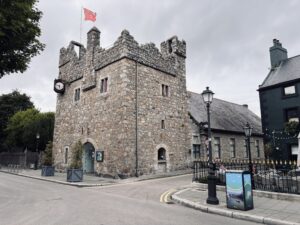
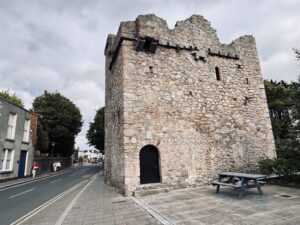
Beneath the roads and railway lines near Crofton Road and York Road lies the ghost of a promontory fort, a type of coastal enclosure in which earthen or stone ramparts were thrown across a headland to create a defensible position on three sides by sea. This particular fort gave the settlement its name, and for centuries it shaped the edge of the coastline here. Today, not a trace of it is visible above ground.
The fort was recorded by Reverend Stokes in 1893, who referred to it as the 'Dun of Dunleary' and placed it to the left of the old pier. Its position had already been captured much earlier on John Rocque's map of County Dublin in 1765, where it appears as a circular mound beside the harbour, suggesting the earthwork was still a recognisable feature of the landscape at that time. At some point, a Martello tower, one of the squat round fortifications built along the Irish coast during the Napoleonic period, was constructed directly in the middle of the fort, effectively occupying its interior. The earthwork itself did not survive the nineteenth century. In 1834, the area was levelled to make way for the railway, and the material dug from the dismantled ramparts was put to immediate practical use, serving as fill to level the ground and as a foundation for the road, as recorded by Casey in 2001.
There is nothing to see on the ground today, which is precisely what makes the site worth knowing about. Walking north of Crofton Road and York Road along the coast, the flat unremarkable surface underfoot is in part composed of the fort's own remains, spread and compacted by Victorian engineers. The Martello tower associated with the site still exists in the area and provides the closest physical link to what once stood here. Rocque's 1765 map, available through various Irish library and archive collections online, offers the most vivid sense of how the mound once sat relative to the harbour.