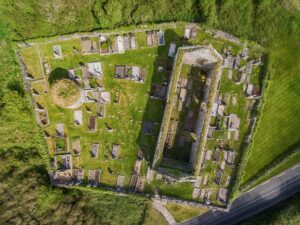
What makes the site at Ballyline quietly strange is not any single dramatic feature but the way several different eras of occupation have settled on top of one another without quite erasing what came before. A moss-covered double-faced stone wall, still standing up to 1.4 metres on its outer face at the west, traces a subcircular enclosure roughly 30 by 28 metres across. Collapsed walling alongside it brings the combined spread to between two and three and a half metres in places. To the south-east and south-west, a shallow ravine about twenty metres wide and three metres deep partly encircles the site, adding a natural element to whatever defensive or territorial logic originally governed the cashel's placing.
The structure was already old enough to be mapped when the first edition Ordnance Survey six-inch sheet was published in 1842, and it appears again, this time with hachuring to suggest its raised form, on the Cassini edition of 1920. By 1996 it was catalogued simply as an 'Enclosure' in the Record of Monuments and Places, a classification that somewhat undersells its complexity. The interior tells a longer story. A livestock pen, measuring roughly nine by five metres, was built against the inner wall face at the north at some later point, making agricultural use of the shelter the old walls still offered. A later drystone wall overlies the original inner wall-face at the south. More intriguing is a small subcircular cairn, about four metres in diameter and only 0.3 metres high, sitting just inside the enclosing wall at the south. A cairn of this kind, a low mound of heaped stone, could represent anything from a cleared field pile to something considerably older, and its position within the cashel raises questions that the available evidence cannot yet settle.
The cashel sits within a wider field system, and wide views open out to the west and north from the rise. The eastern side of the outer wall face is partly obscured by overgrowth, and the rough pasture around the site is described as partly overgrown, so the remains reward a careful look rather than a quick glance from a distance. The livestock gap at the north-east is the most obvious point of entry into what was once a carefully constructed enclosure.