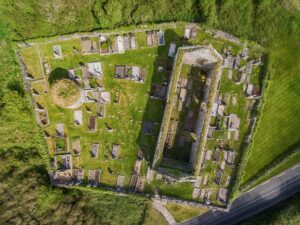
A cashel is a ringfort built from stone rather than earthwork, and they are not uncommon across the Irish landscape. What made this one worth singling out was the masonry itself: not merely competent, but deliberately patterned, with several pairs of upright joints each divided by a course of single blocks, a rhythmic feature that suggests a builder working to a considered scheme rather than simply raising a wall.
Thomas Johnson Westropp, who visited and described the site in 1905, recorded a well-built ringwall with what he called a bold batter, meaning the wall face sloped inward as it rose, a technique that lends both structural strength and a slightly imposing profile. He also noted traces of a gateway at the east, and the foundations of two hut sites within the interior. By the time a field inspection was carried out in 1998, the picture had changed considerably. The gentle inward slope of the base was still faintly detectable, but the gateway and the hut foundations had vanished from view. A drystone field wall, standing between one and two metres high, had been built directly over the cashel's own wall along a large arc from south-west to north to east, effectively annexing the ancient structure into the working fabric of the farm. The outer facing of the original wall, now reduced to a single course in most places, can still be traced around nearly the full circuit. Two more field walls cut across the interior, meeting to the north of centre. About 35 metres to the west lies a wedge tomb, a prehistoric megalithic burial monument, making this corner of Clare a quietly layered place, with early medieval enclosure sitting in close proximity to something far older.