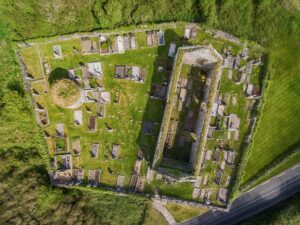
A cashel is a ringfort built from stone rather than earthen banks, and this one at Caherblonick survives in a battered but readable state, its outer wall-face still standing to around 1.6 metres all the way around the perimeter, the collapsed rubble of the wall spreading inward up to six metres in places. What makes it linger in the mind is a description written by the antiquarian Thomas Westropp in 1905, who recorded the masonry as beautiful polygonal stonework, the smooth white blocks very closely fitted together. That quality of construction is harder to appreciate today, but it tells you something about the ambition of whoever built this place.
Westropp's account also noted that the wall had a batter, meaning it was built with a slight inward lean, a technique that adds structural stability and was common in more carefully constructed cashels. Inside, in the north-western sector, there was a hut site, the footprint of a small stone building that would have sheltered the inhabitants. The structure was already significant enough to be marked on Ordnance Survey maps in both 1840 and 1916. Subsequent disturbance to the site is evident in the north and north-west, where material has been cleared away from the inner wall-face, leaving a pit roughly eight metres long and more than two metres deep, now overgrown with briars. A later grass-covered field wall was built across the southern half of the interior, creating a small paddock, evidence of the cashel being put to agricultural use long after its original purpose was forgotten. A second ringfort sits roughly 73 metres to the north-north-east, suggesting this corner of Clare was once more densely settled than its current quietness implies.