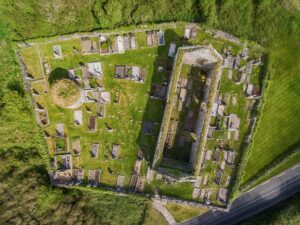
This is a cashel, the term used in Ireland for a ringfort built from stone rather than earth and timber, and it belongs to a class of enclosure that dots the west of Ireland in considerable numbers, most of them associated with early medieval farming and settlement.
The structure is subcircular in plan, measuring around 27 metres across its interior from east to west. Its loose stone wall survives to an internal height of between one and 1.2 metres, and stands roughly a metre on the exterior face, with a width of 1.3 to 1.4 metres along much of its circuit. At the northern arc, the wall has degraded further and survives only as footings, spreading to nearly two metres across where collapse has flattened it. There is a noticeable angle in the wall at the eastern side, a slight irregularity in an otherwise broadly curved line. The site sits on a mix of karst terrain and scrub, that characteristic Burren combination of exposed limestone and low vegetation, though strips of improved pasture run along its northern and south-western edges, a reminder that this part of Clare has been shaped by farming as much as by geology. The enclosure appeared as a hachured feature on the first edition of the Ordnance Survey six-inch map in 1842, and was recorded again on the twenty-five-inch survey of 1897 and the Cassini edition of 1920, giving it a documented cartographic history spanning the better part of eighty years across three separate map editions.