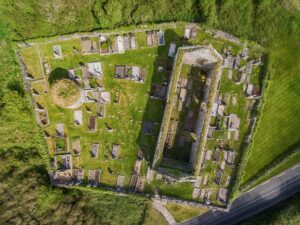
A cashel is a stone-walled enclosure of the early medieval period, the drystone equivalent of the earthen ringfort, and while circular examples are by far the more common form, the Clooneen example measures approximately 46.5 metres north to south and 43.2 metres east to west, its corners curved only at the north-west and north-east. It sits in a slight dip on ground that slopes gently to the south and west, before dropping away at a cliff edge to the south and east, a position that combines natural defensibility with an almost understated placing in the terrain.
The wall itself, where it survives, was once a substantial piece of construction. The north side retains enough of its original form to show a wall roughly 3.4 to 3.7 metres wide, built with internal and external stone facings laid horizontally in two or three courses, each stone around 0.8 metres long and 0.4 metres high. That kind of careful facing work implies a structure that was meant to impress as well as enclose. Much of the western extent has been robbed out over the centuries, the stones carried off for field walls or building work elsewhere, a fate that has visited countless similar sites across the west of Ireland. The eastern side preserves the most, while the south and west have been reduced to faint traces or nothing at all. A spread of stone in the south-west corner may mark where a house once stood within the enclosure. Outside the cashel, a grass-covered bank running from south-east to north-west at a distance of roughly ten to seventeen metres is likely associated with the site. The cashel does not stand alone in the landscape either; two further enclosures lie within about seventy metres to the south-west and north-north-west, and a subcircular cashel sits around eighty metres to the north-east, the whole cluster embedded within an extensive field system that suggests organised and sustained occupation of this ground.