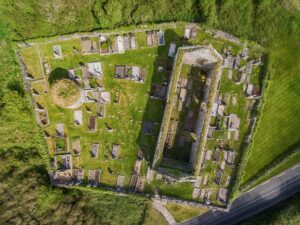
What makes it quietly interesting is a trick the landscape plays: a natural scarp running parallel to the north-west perimeter creates a convincing impression of an internal fosse, the kind of defensive ditch you would expect around an earthwork ringfort. There is no ditch. The ground itself has simply conspired to look like one.
The site is a cashel, a type of ringfort defined not by earthen banks but by a drystone wall enclosure, common across the west of Ireland and typically associated with the early medieval period. This one is roughly circular, measuring about 35 metres across, and its enclosing wall, where it survives from east to north-west, still stands between three and four and a half metres wide at the base, though its height has been reduced in most places to little more than a grass-covered ridge. At the north and north-east, even that much has gone, worn down to a shallow scarp barely twenty centimetres high. Inside, the ground drops away noticeably toward the north-west, a fall of around 1.4 metres relative to the south-east, and a step of exposed rock outcrop breaks the surface near the northern interior wall. A second low internal wall, now collapsed and grassed over, runs across the interior from east to north-west, hinting at some subdivision of the space, though its purpose is not recorded. A single deliberate-looking stone at the south-west, its long axis oriented toward the centre of the site, adds a further detail that resists easy explanation. The cashel was already marked on Ordnance Survey maps of 1840 and 1916, described only as an enclosure when it entered the Record of Monuments and Places in 1996.
The views from the shelf it occupies extend broadly to the east and north-east, which may partly explain the choice of position. In more recent times, a field wall that abutted the north and north-east of the cashel has been removed, and rubble from that clearance is now piled along the surviving eastern wall, a reminder that agricultural tidying and ancient stonework are not always easy to disentangle in a Clare field.