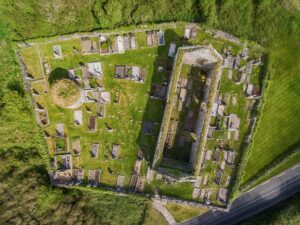
A cashel is a stone-walled ringfort, a type of enclosed settlement common throughout early medieval Ireland, and this one at Drummoher is circular, measuring 35 metres north to south. Its defining feature today is less its walls than the contrast between what remains and what has been quietly borrowed: the southern stretch has been dismantled and rebuilt as a drystone field wall, standing between half a metre and a metre and a half high, the ancient enclosure folded into the working landscape without ceremony.
The site appeared on Ordnance Survey six-inch maps in both the 1840 and 1916 editions, marked with the hachuring used to indicate earthworks and enclosures. By 1996 it was listed simply as an enclosure in the Record of Monuments and Places. The antiquarian Thomas Johnson Westropp, writing in 1905, noted it in passing as a smaller caher, caher being an anglicisation of the Irish cathair, another word for a stone ringfort. His brevity was probably honest: the site is not dramatic in itself. Where the wall has not been robbed out, the stone spread runs between five and eight metres wide, most substantially from the northern to the eastern arc, where a wall width of 3.3 metres is still discernible. A later field wall cuts across the interior, evidence that the enclosure was subdivided at some point after its original use had ended. A second cashel lies roughly 67 metres to the south-west, suggesting this part of Drummoher once held a cluster of such structures rather than a single isolated example.
The cliff edge and the ravine to the west would have made this a naturally defensible position, requiring less man-made reinforcement on those sides. The scrub that now surrounds it has likely helped preserve what remains by discouraging casual disturbance, though it also makes the site difficult to read on the ground.