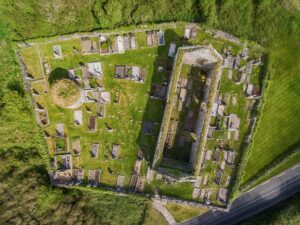
A flat-topped knoll of bare rock, draped in hazel trees and scrubby growth, rises two to four metres above the undulating ground around it, and wrapped around that knoll is a cashel, a type of stone ringfort characteristic of the west of Ireland, where dry-stone enclosures served as defended farmsteads during the early medieval period. What makes the site quietly arresting is this layering of the natural and the constructed: the interior bedrock pushes up nearly a metre above the wall spread itself, so the builders were working around and with the outcrop rather than levelling it away.
The cashel is sub-oval in plan, measuring roughly 27 metres on its north-west to south-east axis and 22 metres across. Its enclosing wall survives as a stone spread between 2.2 and 2.7 metres wide, with an external face of horizontally laid stones still visible in places, standing to around 1.4 to 1.6 metres in height. That facing has been partially obscured in some sections by a later dry-stone wall built on top of it, the kind of quiet repurposing that happened across rural Ireland as field boundaries shifted over the centuries. The east sector is a different matter: here the enclosure is defined by a single boulder wall, which may belong to a separate, later phase of use. The site appears on both the 1842 and 1920 editions of the Ordnance Survey six-inch maps, marked with the hachured symbol used to indicate earthworks and enclosures, which confirms that the structure was recognisable and largely intact across at least those eighty years of mapping.