A cashel is a ringfort built from stone rather than earthen banks, a type of enclosed farmstead common across early medieval Ireland, and this one sat on a gently south-facing slope of a low ridge running roughly northeast to southwest through undulating pasture. By 1999 it had already been reduced to a single arc of overgrown, double-faced stone wall, curving for about forty metres through the southern portion of what was once a roughly circular enclosure some forty metres across. The wall still stood between 0.8 and one metre high at that point, with collapsed stone tumble at its inner base. Within a few years, even that remnant was gone.
The site has been recorded on Ordnance Survey mapping since the first six-inch edition of 1842, where it appears hachured, a cartographic convention used to indicate earthworks and enclosures. It was picked up again on the twenty-five-inch survey of 1897 and the Cassini edition of the six-inch map in 1920, and was formally listed as an enclosure in the Record of Monuments and Places in 1996. The progression from mapped monument to levelled field happened somewhere in the years between the 1999 inspection and the mid-2000s, when satellite imagery showed the last upstanding wall section had been cleared. What remains is legible only from above: Google Earth imagery from January 2011 shows the full grass-covered outline of the enclosing circuit still faintly describing itself across the pasture, and subsurface archaeology is considered likely to survive intact beneath the ground surface.
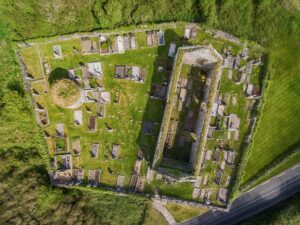
There is little to see at ground level today, which is precisely what makes the aerial evidence so quietly telling. The full circuit of the cashel, invisible to anyone walking the field, resolves into clarity from a sufficient height, a ghostly ring pressed into the grass. It is a reminder that absence above ground does not mean absence below it, and that the early medieval landscape of Clare persists in forms that require patience, or altitude, to read.