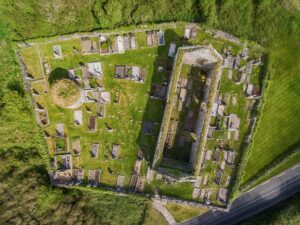
Cartographers recording it in 1996 labelled it a rectangular enclosure, which is technically defensible but misses the point; what survives here is a cashel, a type of early medieval ringfort defined by a stone wall rather than an earthen bank, and it is considerably more complex than a simple rectangular outline would suggest.
The structure is subrectangular rather than truly rectangular, measuring roughly 29 metres north-east to south-west and 27 metres north-west to south-east. Its defining wall, between one and one and a half metres wide and still standing to around a metre or more in places, shows a notable variety of construction depending on where you look. At the south-east, the outer face is built from large, roughly coursed blocks laid with some care, while at the south-west and north-west the builders used thin flagstones laid flat, a technique that speaks to the local availability of Clare's characteristic fissile limestone. The entrance, about a metre wide, sits near the centre of the south-east side. A narrow modern field wall has been built directly over the cashel's perimeter on the north-east and part of the north-west, folding a much older boundary into the practical geometry of later farming. Inside the enclosure, which slopes unevenly downward to the north-west, there is a hut site in the eastern portion, and partly overlapping its south-western edge is a small subcircular feature defined by a low earth and stone bank, possibly a separate structure of a different period or function. The antiquarian T. J. Westropp, writing in 1905, noted a side enclosure to the north-east of the cashel; it does not appear on Ordnance Survey mapping, but aerial imagery has since confirmed the presence of a further subrectangular enclosure of roughly 35 by 28 metres butting up against the cashel at the north-east, defined by a poorly preserved, gapped stone wall. Westropp, it turns out, was right.