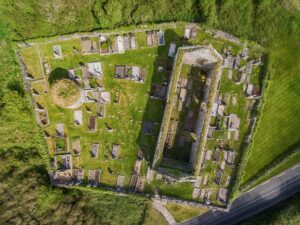
Where the more common earthen ringforts, known as raths, were raised from the soil of the surrounding land, cashels belong to stonier ground, and Clare, with its limestone karst terrain and skeletal fields, has always been good country for them. These roughly circular enclosures were the farmsteads of early medieval Ireland, typically dating from somewhere between the fifth and twelfth centuries, the defended homes of farming families who kept their livestock inside the walls at night and built their houses within the protected interior.
Beyond the classification and the county, the specific history of this particular cashel at Liscullaun remains largely unrecorded in the publicly available literature. No excavation finds, no documented ownership, no recorded folklore has yet made its way into accessible form. That absence is itself a kind of information. A great many of Ireland's ringforts, numbering somewhere around forty thousand across the island, have never been formally investigated, and the majority of those that survive do so quietly in fields and on hillsides, their original inhabitants long anonymous. The landscape of north Clare is thick with such sites, and Liscullaun is the sort of small townland name that rarely appears in published histories but turns up repeatedly on older maps, pointing to a continuity of settlement that predates any written record of the place.