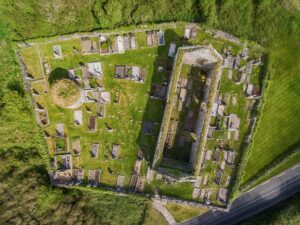
This is a cashel, the term used in the west of Ireland for a ringfort built from stone rather than earthen banks, and this particular example attracted some pointed commentary from the antiquarian T. J. Westropp when he visited in 1911. He dismissed it as a very coarse and badly built caher, which is something of a backhanded way to be remembered by history, though the structures he was measuring were already ancient by his time.
Westropp recorded a low internal terrace running along the inside of the wall, roughly half a metre high and less than half a metre wide, which may have served as a walkway or standing platform. The outer wall-face still survives to between 1.8 and 2 metres on the exterior, and a broad spread of collapsed stone, between two and four metres wide, fills the interior edge. This spread almost certainly incorporates what remains of Westropp's terrace. He also noted a gateway, which he described as defaced, with a small lintel stone measuring just over a metre in length; by more recent inspection this entrance had become impossible to locate, presumably buried under the general collapse. The cashel measures roughly 30 metres in diameter and has been mapped consistently since the Ordnance Survey's first six-inch edition of 1842. What makes its position at Moheraroon particularly interesting is the company it keeps: two further cashels lie within about 100 metres, one to the south-west and one to the north, forming a loose cluster on the same plateau that suggests the area was once a place of some local consequence.