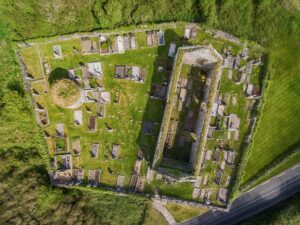
Grass-covered field walls extend from the cashel's northwest and southwest sides, a less overgrown wall runs north, and further sections of curving stone walls lie just outside at the northeast and southeast. The effect, particularly visible from the air, is of a site that once organised the surrounding land rather than simply sat within it, the focal point of an extensive multiperiod field system that predates any tidy historical category.
The cashel itself, a type of stone-walled ringfort common across the west of Ireland, is subcircular in plan, measuring roughly 25 metres north to south and 23 metres east to west internally. Its defining wall, built from regular, thin stone flags in a double-faced construction about 1.35 metres wide, has collapsed considerably over time. The inner face remains legible mainly along the northeast to east arc, while the outer face survives better at the southeast and southwest, with one section partly rebuilt at the east-northeast. At the south, an entrance gap nearly three metres wide is still flanked by its original jambstones, the upright flag on the east side still standing, the western one now fallen flat. Inside, a substantial rubble deposit along the western wall may conceal an earlier internal feature, while a small subcircular cell, roughly four metres by three, survives against the inner wall-face at the north, its walls still rising half a metre. Cells of this kind, built against the interior wall of a cashel, are thought to have served as sheltered outbuildings or storage spaces within the enclosed farmstead.