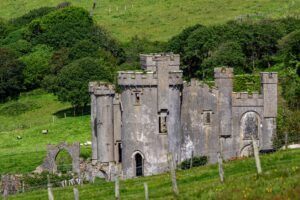
Known locally as Dún Dearg, the site uses a natural ridge of bare rock as its southern wall, with a grass-covered drystone boundary completing the circuit from west through north to east. The result is a D-shaped cashel, a type of early medieval stone ringfort, roughly eleven metres north to south and ten metres east to west. It is not a grand structure, and it has not aged gracefully, but the decision to incorporate the living rock of the knoll into the enclosure's design gives it a quietly practical logic that feels characteristic of the west of Ireland.
A cashel is simply a ringfort built from stone rather than earthen banks, and Dún Dearg, despite its poor state of preservation, follows the form closely enough to read. Near the northern centre of the interior lies a small circular stone-lined depression, about 1.2 metres across, whose original function is not recorded. Two comparable enclosures, referred to as cahers, another local term for a stone ringfort, once stood to the north of this site, though what survives of them now is unclear. George Petrie, the nineteenth-century antiquarian whose observations underpin so much of what we know about early Irish monuments, noted the site as long ago as 1972 in published form, and the area around Streamstown appears to have supported a modest cluster of these enclosures at some point in the early medieval period. The name Dún Dearg translates roughly as the red fort, though no explanation for that colour association survives in the available record.